


The event industry is projected to hit $2.5 trillion globally by 2035. And yet, most event marketers we know are still fighting the same battles: too many events, not enough budget, and a boss who really needs that ROI number.
So we did the work. We partnered with Gatepoint Research to survey senior marketing and event leaders directly, so you're not just getting industry averages. You're getting real data from people doing the same job you are.
One thing before you dive in: benchmarks aren't a scorecard. Your event type, industry, audience, and goals all shape your numbers. These stats are just a reference point, and definitely not a verdict on whether you're doing it right.
The event industry market is growing fast (and getting more complicated)
Event marketing industry statistics are making it clear that the industry isn't just bouncing back post-COVID. It's booming.
According to Allied Market Research, the global events industry market size is expected to reach $2.5 trillion by 2035, growing at a 6.8% compound annual growth rate (CAGR). That's massive growth, driven by increasing demand for in-person experiences, hybrid formats, and virtual accessibility. But growth doesn't just mean opportunity. It also means pressure.
Here's what the event industry market size data tells us:
- Corporate events market: Expected to grow to nearly $600 billion by 2029 (CAGR 10.6%)
- Event management software market: Was over $11.52 billion in 2025 and is poised to exceed $36.42 billion by 2035, growing at 12.2% CAGR
- Virtual events market: $236.69 billion in 2025, expected to reach $537.18 billion by 2029 (CAGR 22.7%)
What this means for you
Companies are investing heavily in B2B events. That's good news if you're trying to secure budget. But it also means leadership expects measurable, revenue-driving results. The bar is rising, and so are the stakes.
55% of event marketing teams manage more than 20 events annually
Event marketing programs are getting bigger, more complex, and more demanding, maxing out event teams and their resources.
The pressure is ON.
To understand just how demanding, Swoogo partnered with Gatepoint Research to survey senior marketing and event leaders across multiple industries. The findings reveal just how intense modern B2B event programs have become:
Who We Surveyed
Leadership Level
Event Program Stats

- 58% manage more than 20 events annually (that's one event every 2.5 weeks)
- 68% run internal events
- 62% run large corporate conferences
- 60% run webinars or virtual events
- 50% host roadshows
- 46% host multi-track events
For most organizations, event marketing is clearly a core growth strategy.
That said, teams are stretched thin. Event planning has consistently ranked as the third most stressful job in the world, and post-pandemic pressures have only made it harder.
Between managing logistics, vendor coordination, attendee engagement, and data reporting, event leaders are doing the work of three people.
What this means for you
Feel like you’re drowning? You're not alone.
The volume and complexity of modern event programs require systems that scale. Tools that automate repetitive tasks, streamline workflows, and support in-person, hybrid, and virtual formats are absolute must-haves.
96% of event leaders lack the data they need to track ROI
Nearly all event leaders struggle to access the data they need to measure event ROI. In a revenue-focused world, that’s the stuff of nightmares.
ROI: Event Data is a Black Hole
Leaders care deeply about ROI, but struggle to measure it
Say post-event ROI data is their biggest frustration
Say wasted budget due to low ROI is the biggest risk
Say it's a breeze to pull event data
When Swoogo surveyed event leaders about their biggest frustrations, the answer was clear—and alarming:
- 56% say post-event ROI data is their biggest frustration
- 40% say wasted budget due to low ROI is the biggest risk of a failed event
- Only 4% say it's a breeze to pull their event data
Read that last one again. Only 4%.
Almost all event leaders are struggling to access the data they need to prove the value of their work, unable to clearly answer basic questions like:
- How many leads did we generate?
- What was our cost per attendee?
- Did this event contribute to pipeline?
Our study also found that pulling and analyzing event data is moderately challenging, but 64% of respondents said that difficulty varies depending on the event type. Translation: some events are easier to measure than others, but not a lot of it feels solid.
It doesn’t help that Forrester's 2024 B2B Events Survey found that only 1 in 5 enterprise organizations have integrated their event platform with their marketing technology. That's a huge missed opportunity, because it means event data lives in a silo. When that happens, it's nearly impossible to connect events to revenue, pipeline, or customer retention metrics.
What this means for you
Leaders typically care deeply about event ROI, but caring isn’t the same thing as actually being able to calculate it.
If you're struggling to prove event ROI to leadership, you're in the vast majority. But the minority of event leaders who find data easy to access have a massive competitive advantage, and (spoiler alert) it almost always comes down to their event technology platform.
READ NEXT
44% of event leaders cited driving registrations as their top challenge
The registration-to-engagement gap is real, and it's growing. Event pros are dealing with challenges across the entire event lifecycle, but the pain points aren't distributed evenly.
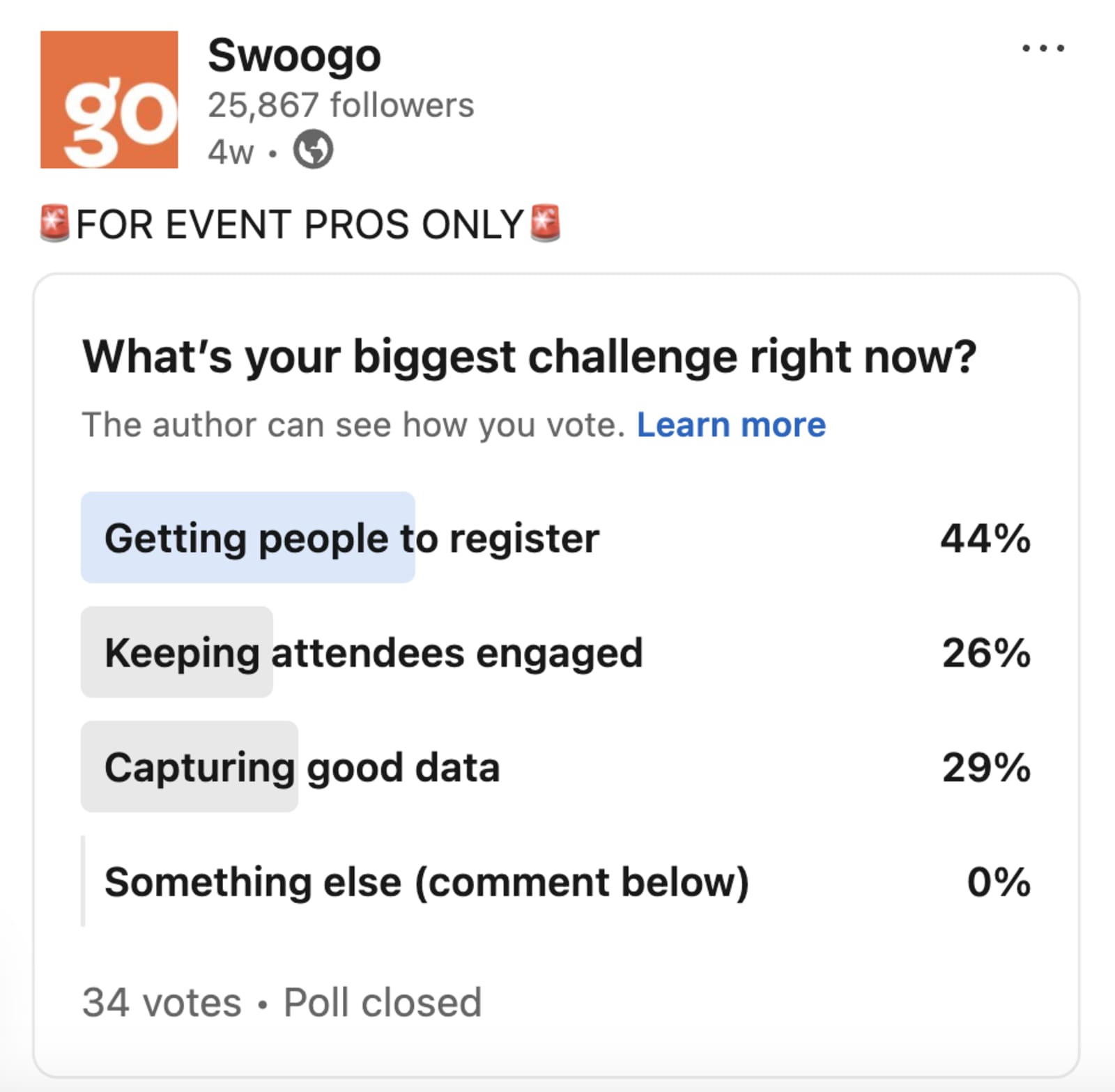
When we asked event professionals on LinkedIn about their biggest challenge, here's what they told us:
- 44% said it was getting people to register
- 29% said capturing good data
- 26% said keeping attendees engaged
While this early LinkedIn poll marked registration as a clear challenge, Swoogo’s more in-depth survey found that post-event challenges had a major impact, too. Nearly half (44%) said their top frustration was attendee engagement tracking, though 42% also said they struggled to drive attendance.
So what's actually happening here? Event marketing pros are fighting on two fronts:
- Getting people to sign up and show up (registration and attendance)
- Proving they actually engaged once they did (aka tracking and data)
You can't solve the second problem if you don't have the right tools from the start. Registration isn't just about collecting names. It's about capturing the right data, personalizing the experience, and setting clear event objectives that tie back to business outcomes.
What this means for you
You need to create experiences valuable enough that attendees stay involved before, during, and after your event. Just as importantly, you also need to have the data systems to prove that engagement happened.
If you can't track who attended what, you can't personalize follow-up. If you can't personalize follow-up, you can't nurture leads. And if you can't nurture leads, you can't tie events to revenue.
The solution starts at registration. Tools that support personalized attendee experiences, track real-time engagement, and integrate with your CRM are essential. And on the day of the event, onsite check-in tools that streamline registration and capture interactions matter just as much as what happens online.
70% of B2B marketers are allocating budget to experiential marketing
After years of digital-first everything, marketers are rediscovering the power of showing up. Whether it's events, workshops, demos, or onboarding experiences, brands that show up in person (or virtually, done well) build deeper loyalty and trust.
According to American Express Global Business Travel's 2025 Meetings Forecast:
- 78% of B2B marketers report allocating budget to experiential marketing
- Less than 30% rate their efforts as established, advanced, or leading
- The rest are stuck in exploratory (35%) or developing (35%) stages
The forecast also revealed two major trends shaping attendee expectations:
- Stronger demand for human connection in an increasingly AI-driven world. While AI is clearly being adopted (50% of meeting professionals plan to use it), there's a rising desire for face-to-face experiences.
- Experience is everything. Content quality and venue selection are now critical. Meeting professionals are investing heavily in creating memorable experiences that go beyond barely-above-boring logistical checkboxes.
In other words, attendees have higher expectations. They want value, connection, and experiences worth their time.
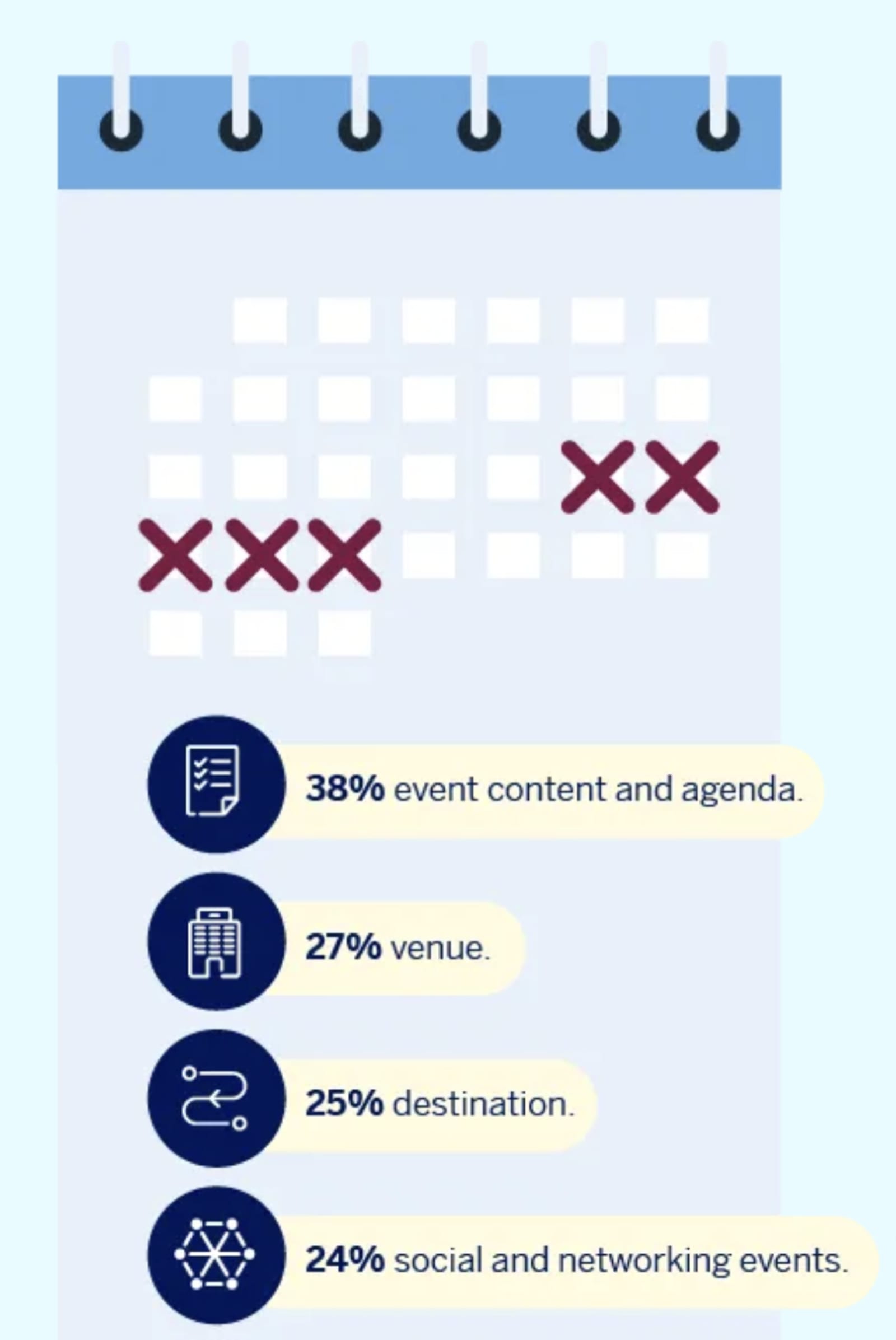
It’s worth noting that American Express (AMEX) report found that 40% of respondents said that an event’s content and agenda impacted attendee experience, but so did venue (27%), destination (25%), and social and networking events (24%). So make sure that the experience goes beyond a simple agenda, and ideally provides opportunities to incorporate local culture, too.
What this means for you
There's a massive opportunity to lead here. If you can run B2B events that deliver clear value, create memorable experiences, and tie back to business outcomes, you'll stand out. Most of your competitors are still figuring it out.
Events aren't just a marketing tactic. They're a competitive advantage for your brand…if you execute them well.
32% of event leaders prioritize flexibility in event software
According to American Express (AMEX), 89% of businesses using event technology save around 200 hours per year. That's nearly five full work weeks, so it makes sense AMEX’s report found that meeting professionals are increasingly planning to use AI-based tools (50%) and mobile event apps (41%) moving forward.
But the question isn’t if event managers want technology. Instead, the question is what do event leaders actually want and need from their technology?
Event Tech Flexibility is #1
What event leaders want most from their tech stack
Flexibility & Scalability
Reducing Team Pressure
Improving Event ROI
Swoogo's survey asked event leaders what their biggest desired win from an ideal event tech stack would be. Here's what rose to the top:
- 32% say flexibility and scalability is their #1 desired win
- 30% want to reduce team pressure due to event volume and complexity
- 26% prioritize improving event program ROI
When asked what event tech investments they'd implement immediately if possible, the top three were:
- Event data analytics
- On-site check-in and analytics
- Customizable registration flows
Notice a pattern? Flexibility. Data. Scale.
These are now baseline requirements for running a modern event marketing program.
What this means for you
If your event platform doesn't let you customize registration flows, pull real-time data, or integrate with your CRM, you're working twice as hard for half the results.
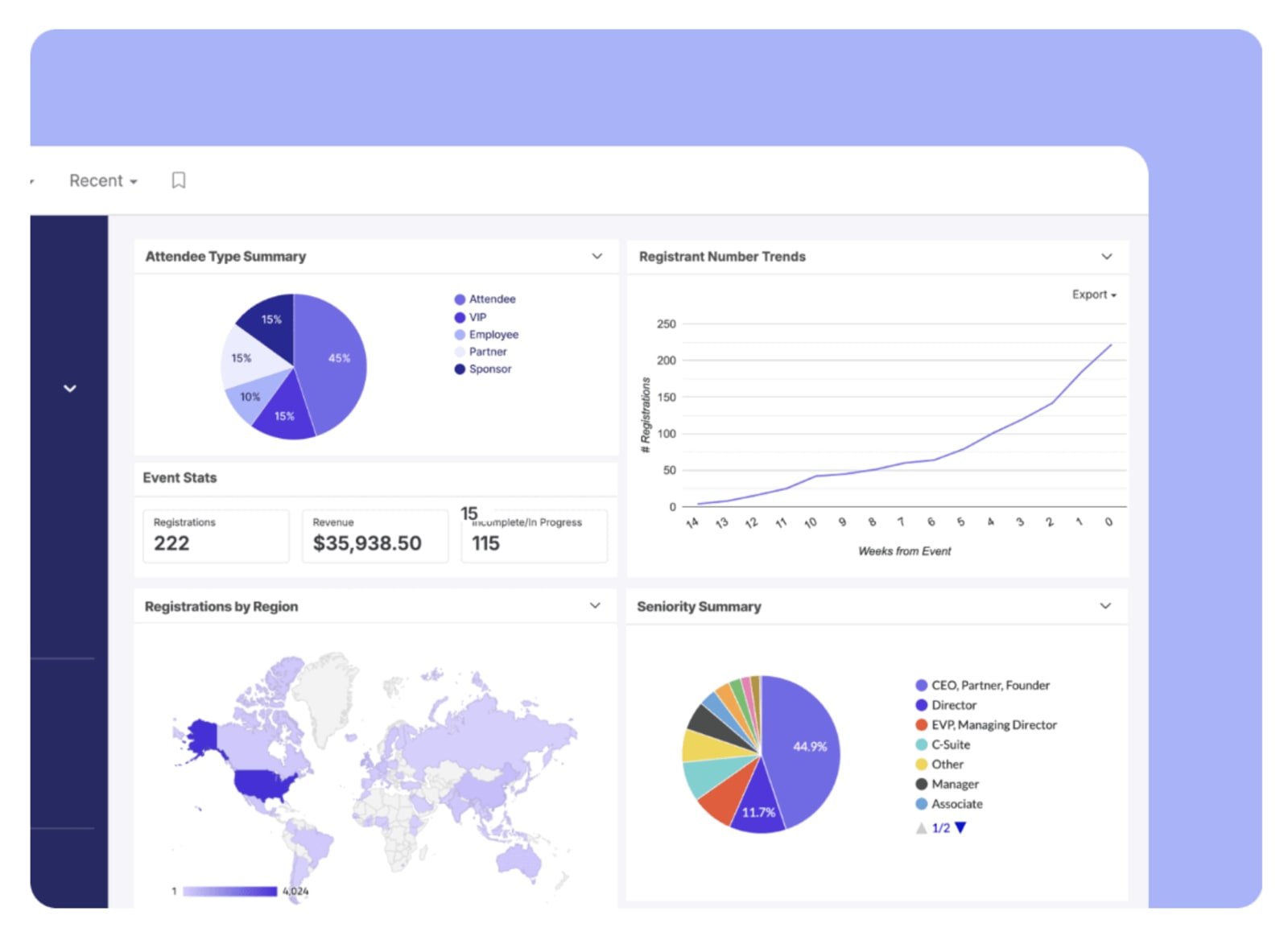
Event leaders don't need more tools, they need better ones—ones that work the way they do, not the other way around. Platforms that force you into rigid templates or charge per event or per registrant aren't built for scale. They're built to extract more money from you as you grow.
Look for technology that offers:
- Flexible, customizable event builders that adapt to your brand and event type
- Robust event data insights and reporting that connect to your CRM and marketing automation tools
- User-based pricing that doesn't penalize you for running more events or driving higher registration
- Onsite tools like mobile check-in and badge printing that make day-of execution seamless
If you're not using integrations to connect event data to your marketing and sales systems, you're leaving money on the table. B2B events generate some of the richest first-party data you can capture… but only if your tech actually lets you use it.
ROI struggles? 2026 is NOT the year
The event industry is growing fast. Teams are running more events than ever, budgets are increasing, and leadership expects measurable results.
Key word here: Measurable.
If you can't prove ROI, your budget is at risk.
Over half (56%) of event leaders say post-event ROI data is their biggest frustration, and 40% say wasted budget is the biggest risk of a failed event. Only 4% say pulling event data is easy.
That's not sustainable.
The event leaders who thrive in 2026 will be the ones working with technology that scales, data that's accessible, and processes that don't require heroics to execute.
If you're still cobbling together spreadsheets, chasing down reports, and guessing at ROI, it's time to rethink your stack. The right platform will give you the insights you need to prove value, secure bigger budgets, and grow your event program with confidence.
Ready to stop guessing and start proving ROI? Swoogo's event registration software gives you the flexibility, data, and scalability you need to run events that drive real business results.
This post was originally published in November 2024, and has since been updated with the latest information.