


Post-event surveys get the least love of any part of the event lifecycle. Plenty of event pros will send a quick “how’d we do?” email while they’re already heads-down planning the next one, and they'll mainly rely on attendance numbers and ticket sales as their main success metrics. Those numbers tell you what happened, but they don't tell you why or what to do differently next time. That's where event NPS comes in.
Event NPS can tell you whether your attendees are likely to come back, if they’ll bring coworkers, and whether you’re building the kind of loyalty that drives long-term outcomes.
In this post, we’ll talk about why event NPS is a critical success and ROI metric and how to implement it for your events to keep attendees coming back.
What is NPS?
Net Promoter Score (NPS) is a way to measure customer loyalty, and is often calculated at different points of the customer journey.
The premise is simple, and you just ask one question: "How likely are you to recommend [this event] to a friend or colleague on a scale of 0 to 10?”
Based on their answer, respondents fall into one of three buckets:
- Promoters (score 9–10): Your biggest fans. They're likely to come back, bring colleagues, and talk up the event to their networks.
- Passives (score 7–8): Satisfied, but not sold. They won't actively hurt you, but they're not driving growth either.
- Detractors (score 0–6): Disappointed attendees who may actively discourage others from attending.
Image suggestion: A horizontal scale graphic (0–10) with color-coded zones — red for Detractors (0–6), yellow for Passives (7–8), green for Promoters (9–10).
How to calculate NPS
More good news for event marketers: Calculating your NPS is as straightforward as the concept.
The math is easy once the Net Promoter surveys come in:
NPS = % of Promoters − % of Detractors
Image suggestion: A simple formula graphic showing the NPS calculation with a worked example. Could style as a "scoreboard" visual with Swoogo branding.
For example, If 60% of your respondents are Promoters, 25% are Passives, and 15% are Detractors, your NPS is 60 − 15 = 45.
Passives, as you may have noticed, are typically excluded from the calculation entirely. That said, it doesn’t hurt to take a look at your total percentage of passives for your own knowledge so you can see how many attendees thought your event was fine. This data matters, too.
Scores range from −100 if everyone is a detractor (yikes) to +100 if everyone's a promoter (crushing it!). Most events, naturally, land somewhere in between.
Why every event marketer needs to be measuring event NPS
Attendance numbers are a lagging indicator. By the time you notice a downward trend, you've already lost ground. NPS is a leading indicator, meaning it tells you where things are headed before it shows up in registration data. That’s already a huge perk, but tracking it has additional benefits, too.
Here's why NPS deserves a permanent place in your events program.
1. It gives you credibility with leadership
One of the biggest challenges in event management is demonstrating value beyond revenue, and 96% of event marketers say they lack the data they need to prove ROI.
NPS gives you a quantitative read on attendee sentiment, which means you can finally translate the subjective "feel" of an event into a number that executives and stakeholders actually trust.
C-level leaders are already familiar with NPS as a business health metric. Bringing it into your event reporting means you're speaking their language instead of asking them to interpret a stack of session ratings and attendance charts.
A few reasons it lands with leadership:
- Credibility: NPS is a recognized benchmark across industries, so stakeholders don't need it explained to them.
- Universal language: It connects event performance to the same loyalty and advocacy metrics leadership already tracks across the business.
- Trackability: You can show improvement over time; instead of "the event went well," you can say "our NPS went from 34 to 51 year over year."
That trend line is your best tool for making the case for resources. It's a lot easier to ask for budget to fix a venue issue, upgrade AV, or add a networking hour when you can point to specific feedback patterns and their impact on your score.
2. It ties events to business metrics beyond revenue
Revenue alone doesn't capture the full impact of an event. NPS gives you a broader lens that connects your events to long-term business goals rather than just ticket sales.
With NPS, you can:
- Benchmark performance: Track attendee sentiment across your events to identify trends, spot weak spots early, and build a clear picture of what's working.
- Uncover attendee loyalty: Are attendees becoming more deeply connected to your brand over time? NPS is one of the clearest signals you have.
- Make data-driven decisions: Are certain event formats driving higher scores? Is a specific type of content or session structure getting more traction? NPS gives you the evidence to act on those patterns with confidence.
Event leaders who track NPS consistently can measure success in ways that align with business goals and make a compelling case that events are a growth driver.
3. It helps you identify event advocates that can drive growth
Your Promoters (the 9s and 10s) are more than satisfied attendees. They're an asset you can actually leverage.
When you can identify this segment, you can put them to work:
- Fuel word-of-mouth: Encourage them to share their experience on social, write a review, or recommend the event to peers. This is the most credible marketing you'll ever get.
- Build an ambassador program: Turn your top Promoters into VIPs by involving them in post-event campaigns, testimonials, or referral programs to bring in more like-minded attendees.
- Drive retention: Nurture this group to increase return attendees, as it’s one of the highest-ROI actions you can take between events.
4. It helps create cross-team alignment on event goals
NPS can create alignment across the teams that actually run events. When everyone from marketing to sales to event ops is working toward the same metric, it fosters a shared sense of accountability and makes improvement a collective goal rather than one team's problem.
NPS results can pinpoint which areas need attention and give each team a concrete target to work toward. With consistent tracking, you can build iterative strategies to improve every stage of the attendee journey (and not just the parts that are easiest to measure).
5. It helps you optimize what’s working (and stop what isn’t)
This one is less about leadership and more about the day-to-day of running a great event program.
NPS is one of the best tools you have for proactively catching recurring issues before they compound. If your venue is consistently dragging down scores, that's clearly a pattern you need to resolve. If a particular session format keeps underperforming, you now have the data to make a different call next time.
The key is getting granular. Rather than collecting one overall event NPS and calling it done, consider layering in survey touchpoints across:
- Every session or talk an attendee signed up for
- Specific activations, such as happy hours, workshops, networking events
- Breakout sessions and roundtables
- The overall event experience
With that breakdown, you move from "the event went okay" to "the morning keynote and the evening activation scored 20 points higher than the afternoon breakouts, so here's what we're changing." That kind of operational clarity makes your next event meaningfully better than your last.
6. It can help you compare performance across your entire event portfolio
Want an apples-to-apples comparison? If you're running 10, 20, or 50+ events a year, you need a way to benchmark them against each other.
Event NPS gives you a consistent metric across your entire portfolio, regardless of format, size, or audience. That means you can identify which events are resonating most with your audience, understand whether in-person events outperform virtual for your specific attendees, and surface which events are punching above their weight. And then, you can figure out why.
The events that consistently score highest tell you something important about what your audience actually values. The ones that consistently underperform give you a clear signal about where to rethink your investment.
Over time, this comparison can (and should!) inform your full event strategy to make sure you’re creating must-attend events that your specific target audience will love.
7. It helps you close the loop with detractors
Not everyone is going to leave your event as a raving fan. That's okay. The goal isn't a perfect score, it's a better one than last time.
But detractors are worth your attention for two reasons.
- They're a goldmine of actionable feedback. They had a specific problem, and if you can identify it, you can fix it before it affects your next event.
- Detractors talk. A frustrated attendee who feels ignored is far more likely to share that experience with their network than a satisfied one. Left unaddressed, detractors can actively work against future attendance without you ever knowing.
Following up directly with a short, genuine email acknowledging their experience and asking what would have made it better goes a long way. It shows you're listening, and it can turn a negative impression into a neutral or even positive one.
And at minimum, it gives you the qualitative context to understand the "why" behind a lower score and make sure it doesn't happen again.
How to implement NPS for events
Knowing you should measure NPS is one thing. Actually building it into your event program is another.
Here's a step-by-step approach to doing it right, from timing your survey to making sure the data actually changes something.
1. Decide when to send your NPS survey
Timing matters more than most people realize.
Same-day surveys (sent within a few hours of the event ending) catch attendees while the experience is still fresh. Response rates tend to be higher, and the emotional recall is sharper. This works especially well for in-person events where attendees may be traveling home and have phone time or virtual events when attendees are already in front of their computer.
24 to 48 hour surveys give attendees a chance to decompress and reflect, which can lead to more thoughtful responses. This works well for multi-day conferences where attendees are still processing on day one.
Here’s some general guidance:
| Event type | Recommended send time | Why |
|---|---|---|
| In-person (single day) | Same day, within 2 to 3 hours of close | Attendees are traveling home and have phone time while the experience is fresh. |
| In-person (multi-day) | 24 to 48 hours after the final day | Gives attendees time to decompress and reflect on the full experience. |
| Virtual | Same day, within 1 to 2 hours of close | Attendees are already at their computers and the event is front of mind. |
| Hybrid | Same day for virtual attendees; 24 hours for in-person | Different experiences warrant different timing. Don't send one blast to both. |
While your timing will depend on multiple factors, there’s one hard rule to always follow regardless of event type: response rates drop significantly after 48 hours. The further you get from the event, the less likely people are to engage and the less reliable their recall will be, even if you delivered true onsite event magic.
We recommend making this as seamless and automated as possible. If you're using Swoogo's event registration software, you can build post-event surveys directly into your communication workflows and schedule them to go out automatically, so the timing is always right and nothing falls through the cracks in the post-event scramble.
It's also worth deciding early whether you're collecting one overall event NPS, or separate NPS scores for specific activations, keynotes, or breakout sessions. For large conferences, session-level tracking gives you a richer picture, but don't overdo it or you’ll run the risk of attendees getting survey fatigue. One NPS survey per major touchpoint is plenty.
2. Ask the right questions
The core NPS question is standard: "On a scale of 0–10, how likely are you to recommend [Event Name] to a friend or colleague?"
After that, keep it short. The goal is a high response rate, which means the fewest number of questions you need to get clarity. Aim for 3 to 5 follow-up questions max, and make them optional. Anything beyond that and you'll see drop-off.
Good follow-up questions to consider:
- What was the highlight of the event for you?
- What would have made your experience better?
- Was there a session or speaker you'd want to see again next year?
- How would you describe this event to a colleague?
- What's one thing we should add or remove?
The open-ended questions are gold. Qualitative patterns in the responses—such as multiple people mentioning the same venue problem, audio issue, or session topic—give you the "why" behind the number.
3. Segment your results
A single aggregate NPS score is a starting point, not a conclusion. And if you rely on a single NPS score, it can mask significant variation across your attendee base.
Here are a few ways to slice the data that actually move the needle:
- By attendee role or persona: Are your practitioners scoring differently from your decision-makers? If executives are consistently scoring lower, that might tell you something about the depth of content or the networking opportunities.
- By sessions attended: Which sessions drove the highest NPS? Which pulled it down? This is incredibly useful for speaker selection and agenda planning.
- By ticket type: Are VIPs having a different experience than general admission? Are sponsors satisfied with the visibility they got?
- By event format: Comparing in-person vs. hybrid vs. virtual NPS across your portfolio can help you make smarter format decisions going forward.
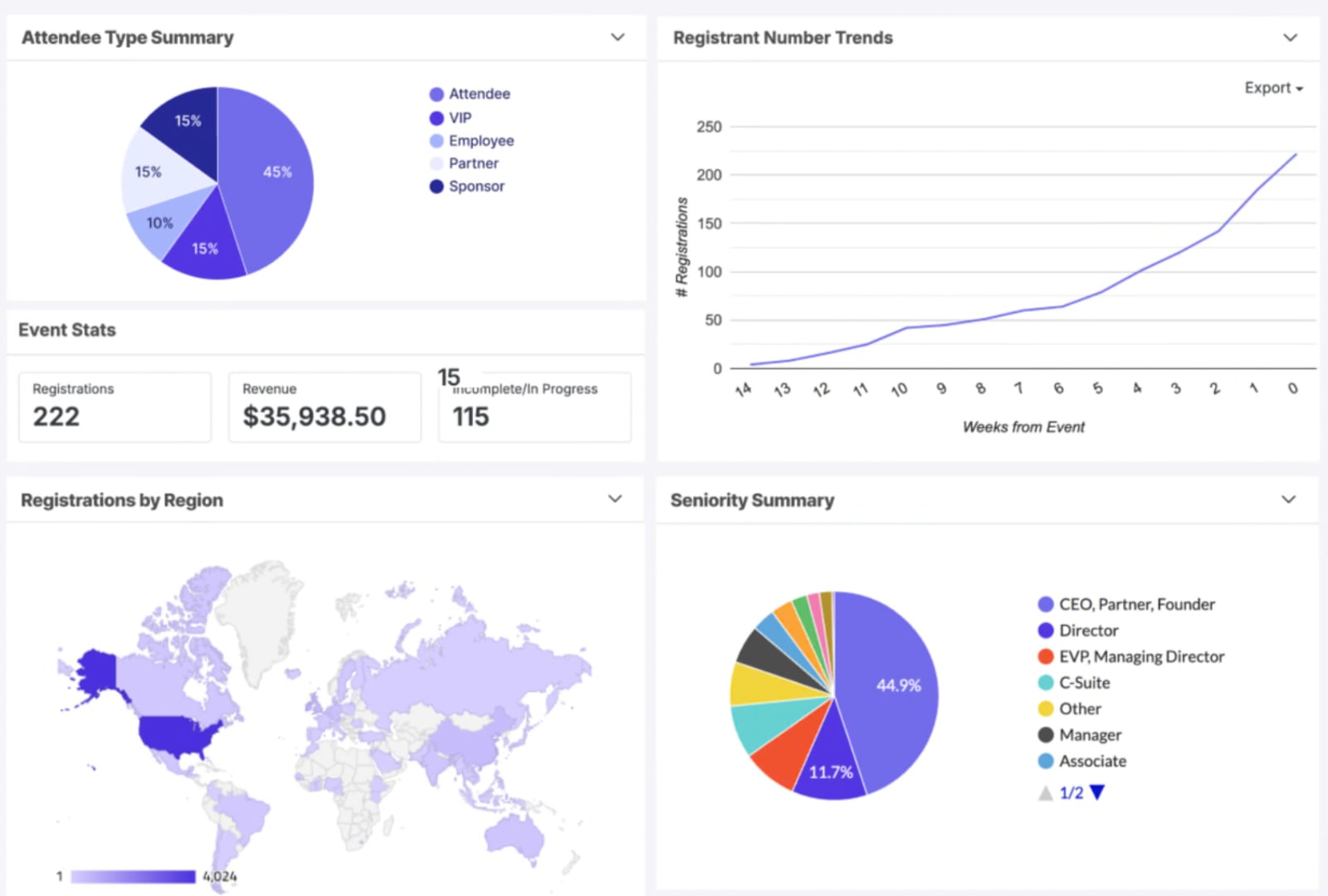
Swoogo's event analytics and reporting tools let you build custom dashboards and segment data directly within the platform, making it easier to track KPIs and data segments.
4. Benchmark your scores meaningfully
Wondering what’s a good NPS score for an event? It’s a good question.
Benchmarks for event NPS aren't as standardized as they are for, say, SaaS or retail. And that's okay. Any event NPS benchmark you find online should be treated as directional guidance, not gospel. A score of 40 might be excellent in one industry and mediocre in another.
General NPS benchmarks across industries tend to suggest:
- Above 0: More promoters than detractors, so this is quite literally the minimum baseline to clear.
- 30–50: Good, your event is resonating.
- 50+: Excellent, you’re building strong loyalty and advocacy.
- 70+: Exceptional and rare, but it happens with highly engaged communities.
Remember, you’ll want to distinguish between internal benchmarking and industry benchmarking:
- Internal benchmarking: Comparing events against each other and against your own historical scores. Most actionable.
- Industry benchmarking: Useful for context and goal-setting, but treat it loosely.
The most valuable benchmark is your own event history. When you track NPS across every event and over time, you create a constant in your own audience. That gives you a much more meaningful baseline than any industry average, and gives you realistic but meaningful event goals to work towards.
5. Close the loop with each audience segment
Collecting NPS data is the easy part. What you do with it—and how fast you do it—is what separates event programs that improve from ones that plateau.
Every segment of your audience is telling you something different, and each one deserves a different response. Ignore this step and the data is just a number. Act on it and it becomes a competitive advantage.
Here are some guidelines for how to follow-up with each group based on their NPS survey responses:
| Segment | When to follow up | What to say | Actions to take | Goal |
|---|---|---|---|---|
| Promoters | Within 1 week | "You made [Event Name] what it was—thank you. We'd love to keep you close to what we're building next." | Ask for a testimonial, LinkedIn post, or referral. Invite them to speak or join an ambassador program. | Activate advocacy and drive referrals for future events |
| Passives | Within 1 to 2 weeks | "We're glad you joined us, and we're already working on making the next one even better. Here's what's changing." | Share a preview of improvements. Offer early access or a discount to the next event. | Convert to promoters by showing you're listening and iterating |
| Detractors | Within 3 to 5 days | "We noticed your experience didn't quite land the way we hoped. We'd genuinely love to hear what we could have done better." | Reach out personally, listen without defensiveness, log the feedback, and close the loop once changes are made. | Prevent negative word-of-mouth and recover the relationship |
Keep in mind that for detractors especially, timing matters. Reach out within a week while the experience is still relevant. A simple, human note (not an automated campaign) goes a long way.
6. Feed NPS data back into your next event
NPS data is only useful if it can actually change something.
Once you've collected and segmented your results, look for patterns in the qualitative responses. Are multiple attendees mentioning the same venue issue? Same speaker? Same session format that felt flat? These are the signals you need to pay attention to.
Use NPS insights to make concrete decisions:
- Content selection: If certain session topics consistently drive high NPS, prioritize them, and if a keynote format underperforms year after year, try something different.
- Registration flow: Attendee frustration at your event registration often shows up in follow-up responses using phrases like "confusing," "took too long," "too many steps." That's a fixable problem that directly affects event satisfaction before doors even open.
- Venue and logistics: Noise, parking, wifi, food—these surface consistently in open-ended responses and have an outsized impact on experience even if they don’t seem like major details at a first glance.
- Session format: Workshops and interactive formats often outperform traditional panel discussions. If your NPS data supports that trend, lean in.
And here's where your event platform does the heavy lifting: by sending post-event surveys directly through Swoogo, your NPS data lives in the same ecosystem as your registration data, attendee profiles, and session engagement metrics. You can push these data insights into your CRM so your sales team knows which attendees are promoters and likely warm leads, and which ones had a rough experience before they reach out.
Stop flying blind after your events
Ticket sales tell you who showed up. Event NPS tells you whether they'd come back—and whether they'd bring 10 colleagues with them.
For event marketers running 10, 20, or 50+ events a year, that distinction matters. A rising NPS trend is evidence that your program is working, while a declining one is a heads-up before it shows up in registrations. And the patterns buried in your qualitative data? Those are your best roadmap for what to build next.
You don't need a fancy research team to get started. You need a consistent question, the right timing, and a commitment to actually doing something with the answers.
Ready to build post-event attendee surveys and NPS tracking into your processes? Swoogo makes it easy to collect, segment, and act on attendee data—all in one place. Check out our event registration software or request a demo to see it in action.